



The importance of early spring nutrition for oilseed rape
 Growers of oilseed rape (OSR) are being urged to prioritise early spring nutrition as soon as regulations and weather patterns allow.
Arable farmer and BASIS-qualified agronomist Will Oliver, who is growing OSR for the first time in five years, says he is keen to encourage strong crops that are resilient to common challenges like cabbage stem flea beetle (CSFB).
“Weaker crops become more susceptible to threats like CSFB, so it’s vital to provide a strong line of defence as soon as possible,” he says.
Overcoming threats to OSR
While opting to grow LG Avenger for its CSFB resilience, alongside DK Exstar, Mr Oliver stresses that safeguarding a crop ultimately depends on proactive nutrient management.
He says CSFB remains the biggest threat to OSR production, and even resistant varieties can be susceptible when plants are undernourished or slow to establish, leaving them vulnerable to grazing adults and larvae that attack stems and leaves.
“Once larvae enter the plant, they disrupt nutrient flow and weaken stems, often reducing yield potential or even causing plant loss in severe cases,” adds Mr Oliver.
“A well-nourished OSR plant has a much better chance of withstanding any stress caused by challenging spring conditions and will be much better able to grow away from pest damage, such as that caused by CSFB.”
Alongside CSFB, he says slugs and pigeons also carry persistent pressures – especially when crops establish unevenly.
“A weak or patchy crop creates open areas for birds to land and feed, damaging crops at a stage when plants are most vulnerable,” explains Mr Oliver.
He uses gas bangers and flags to deter pigeons, but says the best defence is a strong, well-nourished crop from the start.
“By getting a first dose of nitrogen and sulphur on the crop as soon as conditions allow, you ensure that the plant has the resources it needs to defend itself,” he explains.
For more information on the effects of weather on OSR, read our recent blog.
Timely fertiliser application
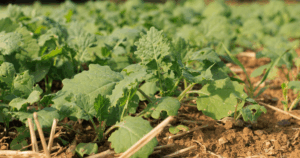 Mr Oliver plans to get a first dose of nitrogen and sulphur on the crop as soon as the ground can be travelled on, highlighting the importance of timing.
“The key is not to delay that first nutrition pass; you want to get it on before the crop starts to elongate too much,” he explains.
“If you wait for perfect conditions, you could miss the window. By then, the crop might already be stressed, and it will be much harder for it to recover if hit by poor weather or pressure from CSFB or other pests.”
Mr Oliver explains that as OSR enters its rapid growth phase and nutrient demand rises rapidly as the weather warms.
“Ensuring fertiliser is readily available before this point is vital to support vigorous development,” he adds.
“Once flower buds start to form, that’s when the crop needs the most nutrients available to fuel strong, even growth.”
He also believes the main advantage of getting nutrition right from the beginning is the difference it makes later in the season.
“A good, well-fed crop can grow away from pest and weather damage, but a weak one will always struggle to catch up,” explains Mr Oliver.
“By aligning fertiliser applications with the crop’s key growth stages, growers can optimise nutrient use efficiency and set OSR up for sustained performance through spring and summer.”
Soil testing
Incorporating soil testing into a comprehensive nutrient management plan will allow for optimised nutrient applications, maximising nitrogen use efficiency (NUE), says Mr Oliver.
“Since nitrogen plays a vital role in early spring OSR growth, measuring the soil’s nitrogen levels ensures that the crop receives the right amount without the risk of over–application, which can lead to lodging or excessive vegetative growth later in the season,” he explains.
“By tailoring nutrient applications based on soil test results, farmers can optimise early OSR nutrition to not only enhance pest resistance but also improve crop resilience and yield potential.”
Find out more about the importance of soil testing in our recent blog.
The best fertiliser for OSR
Mr Oliver recommends using a compound fertiliser that provides both nitrogen and sulphur in a balanced formulation.
“By spring, the crop should be in its vegetative growth stage, when sulphur is required most for healthy growth, helping the OSR plant establish a strong foundation,” he explains.
“Sulphur is also crucial for protein synthesis and oil production in OSR crops, especially during the reproductive stages”
He says Dynamax is a compound fertiliser option combining 27% nitrogen (N) and 4% sulphur (S), making it the ideal balanced fertiliser for early spring OSR nutrition, ensuring an optimised supply of essential nutrients, supporting growth from early spring.
Read our recent blog for more information on the importance of soil nutrient supply.
Split dosing
For the best results, Mr Oliver says fertiliser should be applied in split doses to match OSR’s changing nutrient requirements.
“OSR’s nitrogen demand builds progressively through the spring, so splitting applications allows us to match requirements as it develops,” he says.
“This supports canopy building early on, then maintains growth into flowering and finally drives seed set.
“Split dosing is about managing the timing of N, not just the total quantity. It consistently delivers better NUE, reduces risk, and supports yield and oil content far more effectively than a single early application,” he adds.
For guidance on the correct timings of nitrogen applications for OSR, see Mr Oliver’s recommendations in the table below:
| Timing | Growth stage | N application |
|---|---|---|
| Early spring (Feb–Mar) | Early stem extension | 50–60% of total N to build the foundation of the canopy without over-stimulating |
| Mid spring (Mar–Apr) | Green bud to flowering | 30–40% to support flowering and maintain growth through this key demand period |
| Late spring (late Apr–May) | Pod set | 10–20% to support pod and seed fill, especially where rooting and moisture levels are good |